
Interview editor
A guest speaks softly beneath a licensed music bed. Removing the bed may also thin out quiet syllables.
Compare the first and last words of each answer with the source before cutting the interview.
music remover from videoAudio workflow
When voices and background music occupy the same recording, separating them can help you focus on the dialogue. Keep the original file so you can compare it with any processed result.
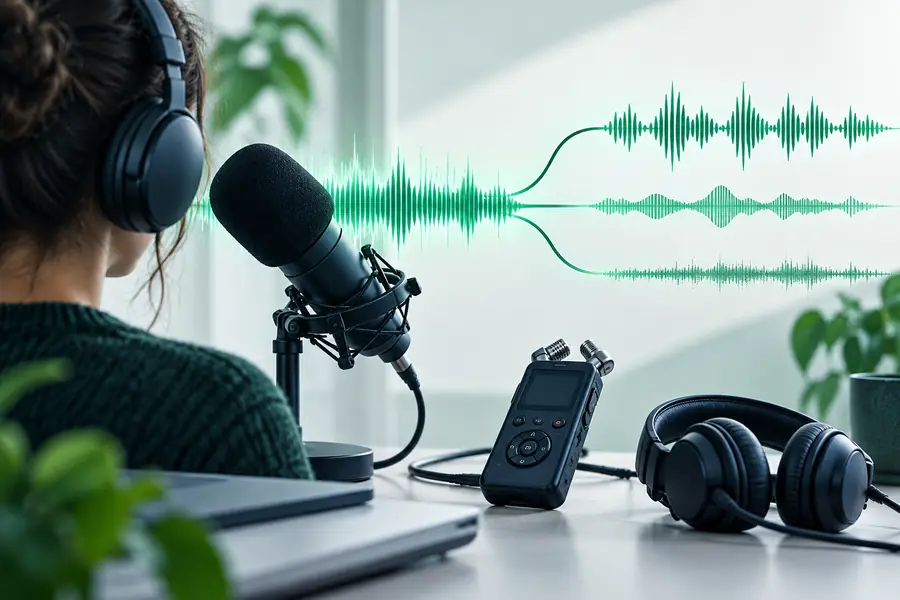
Compare the mixed source with a voice-focused representation. These images illustrate the listening task; they are not audio samples or proof of a processed result.

 Mixed source
Voice focus
Mixed source
Voice focus
A visual comparison cannot reveal whether consonants, pauses, or room tone survived. Listen to both recordings before using the result.
Different recordings expose different trade-offs. Removing music can also change sounds that overlap with speech.
A guest speaks softly beneath a licensed music bed. Removing the bed may also thin out quiet syllables.
Compare the first and last words of each answer with the source before cutting the interview.
music remover from videoIntro music continues under the host's opening sentence. A voice-focused result may retain traces of the melody.
Check the overlap at the transition, where abrupt changes are easiest to hear.
music remover from videoA lesson recording contains narration, music, and notification sounds. Processing may alter more than the music.
Review the spoken instructions and any sounds learners need to recognize.
music remover from videoThe useful output depends on what is already mixed into the file. This table compares the source recording with the voice-focused result you should evaluate.
Original mix
Voice-focused result
Original mix
Heard alongside every other recorded sound
Voice-focused result
Intended to be easier to hear, but may sound altered
Original mix
Present at its recorded level
Voice-focused result
Targeted for reduction; remnants may remain
Original mix
May be masked by music
Voice-focused result
May become clearer or lose detail during separation
Original mix
Part of the continuous recording
Voice-focused result
May change or become uneven
Original mix
Contain the recorded music
Voice-focused result
May reveal residual sound or processing artifacts
Original mix
Reference for meaning, timing, and natural sound
Voice-focused result
Candidate track to review before editing or publishing
Listen with the original beside you. Check a loud passage, a quiet sentence, and a gap with no speech rather than judging only the first few seconds.
If the music overwhelms a consonant in the source, separation cannot reliably reconstruct what was never clearly captured.
WorkaroundCompare against the original and, where possible, request a cleaner recording.
Musical notes, echoes, or warbling may remain in pauses after processing.
WorkaroundInspect speech-free gaps separately and make small edits only where they do not cut into dialogue.
A music remover from audio may affect breaths, room tone, or sound effects that share frequencies with the music.
WorkaroundCheck those details against the source and retain the original as a reference.
Describe the voice you want to keep, then evaluate any result against your original audio. Musicremover directs you to the processing tool; available inputs and results depend on that tool.
Process my audioA voice-focused process aims to reduce music while retaining speech, but those sounds can overlap in the recording. Listen for missing syllables or changes in voice quality before using the result.
Music that is loud relative to the speaker, or that overlaps the speaker's pitch and timing, is especially difficult. Quiet voices and heavily compressed recordings also leave less detail to work with.
Not necessarily. Residual music, room sounds, and processing artifacts can remain, particularly between spoken phrases. Compare several points in the result with the original recording.
Keep the original as your reference for words, timing, and natural sound. Use a processed version only where your listening check shows it improves intelligibility without losing important details.